we gotta do something about the bots
I checked out Twitter for the first time in ages to see if anyone had been finding anything in the Epstein files
Which, holy shit.
I'd heard journalists describe twitter as the place where narratives hatch, but it was surreal seeing the process happen so quickly.
Scrolling deeper and deeper down, I was hypnotized, feeling like I was wrapping my own red yarn around thumbtacked headshots, drawing my own connections as to what it all meant.👨🍼
Little did I know, it's conspiracy all the way down.
Underneath any high traction tweet I saw, there would inevitably be 3 or 4 replies running interference on its narrative. One would discredit it. One would downplay it. One would distract from it. It's clear there's a bot campaign trying to astroturf the cycle, and whoever's behind it is trying to impede democracy.
Later in the week, on a YouTube video about changing the clawback mechanics for canada's old age security pension, someone claiming to have worked their whole life for their pension had left a much-upvoted comment that was opposed to the idea. I replied pointing out it would only apply to people over 65 earning more than 100k a year. There was some more back and forth - the research took me maybe 20 minutes. Once my replies started getting upvoted, the OP deleted the post and everything went away.
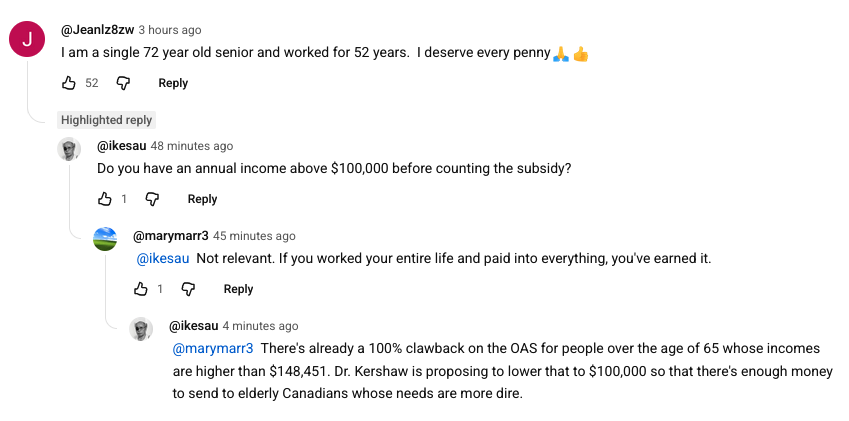
There's no way to verify this, but I really doubt @Jeanlz8zw is a real person.🪒
How much of our sense of reality is steered by strangers who want us to be confused, mislead, misinformed, or angry?
Can anything be done?
Something I've wanted for at least 10 years now is for governments to offer identity verification services for social networks.
Here's how it could work:
- When I apply for a passport, I'd also get an account at identity.gov
- When I sign up for a social network account, I can link it to my identity.gov account
Now, whenever I post something, I'd get a few affordances.
(These next two blocks are interactive.)
Then, when I go on YouTube, I can filter comments based on these 3 properties:
Now. There are lots of concerns any reasonable person would have.
Won't this just lead to mass surveillance?
Not to be defeatist, but we already have it.
We can avoid making it worse, though.📈
Zero-knowledge proofs are a cryptographic technique that allow people to make verifiable claims without revealing any other information about them in a way that can't be linked back to your actual identity in the government's registry.🧑💻
The technical details aren't the emphasis of this piece. Just imagine that the government made a billion unique stamps, and handed out one to each of its citizens at random. Each citizen could then stamp their documents, readers could verify that the stamp was authentic, but the government wouldn't know which stamp belonged to which citizen, or what its citizens were doing with their stamps.
That's the gist of the thing I want. It is not a centralized government database that tracks all of our online activity and links it to our real identities.
Won't this chill speech?
Possibly! Though I think it being gradated and opt-in drastically softens the extent to which it would.
We also need to understand that speech is currently already chilled, just in a different way. I've stopped replying to people on the internet because I've lost confidence that they'll respond in good faith.
I worry for the world in which no one is anonymous online, but I also look forward to the day that I can read an angry man's comment on bike lanes and know that he's an honest-to-goodness ignorant Canadian and not a troll for a national disinformation department or PR firm.
Won't people just sell their tokens or let AI agents use their signatures?
I think all signatures will have to have a persistent identity such that you can always view someone's posting history.
So you'd get a stable pseudonym like human-xyz that is attached to all your human-signed posts.
Your citizen and personal signatures would get different pseudonyms, so that they can remain separate. This would have to be per-platform, so that you could have a different identity on Substack than AO3.
e.g. these would both be you:
- substack-citizen-123
- ao3-citizen-456
Though obviously if you signed posts on both with your full name, anyone could connect your accounts.
This would allow us to filter/tag/shame people who sell their accounts if we see that they're spamming.
Won't semantic analysis break anonymity anyway?
Yes, probably.🕵️ If that becomes a real problem, I guess we'll get tone masking services that rewrite your original message to remove your idiosyncracies for the especially privacy-valuing people (who are probably already doing this)
Won't an opt-in system eventually become mandatory?
The scope creep objection. It starts out optional but norms develop that pressure us to sign everything and disregard anything that isn't signed - ratcheting society towards less anonymity.
This seems like a real possibility to me, but I can still see it happening democratically. A decade of experience with the system leads people to conclude that generally, this is a healthy norm that has been beneficial for society. Something that feels more like mandating seatbelts than Ring cameras becoming ubiquitous.
That's my idealism, though. Realistically, it's contingent on the government and society that's implementing this technology.
Won't this exclude people who can't get passports?
I have trans friends who can't return to the U.S. without getting their passport revoked now. They're fearing for their lives and freedoms, and it's incredibly tone deaf of me to propose that we further empower the state to identify them.
I guess I just bite the bullet on this one. My belief is that this US administration exists because we didn't have this system in place in 2015, allowing the US political discourse to get hacked by Russians on social media. Obviously there were lots of other factors, but it seems quite plausible to me that adverserial nation states tipped the balance in what was an extremely close election.
I wish the world was safe for everyone. I wish that all our governments were trustworthy and progressive, but they're not. We need to find approaches that can help incrementally improve them.
This proposal seems unlikely to happen by default, and I would really strongly oppose a system that would forcibly de-anonymize everyone on the internet. My hope in writing this post is so that people who oppose online identification systems have something else other than a total rejection of the idea to point to when they raise their concerns.
Why does a government need to run this?
Big political science question! What is the role of government? Can it be trusted? Do we need a semi-adverserial relationship between the public and private sectors to guard against creeping state totalitarianism?
I don't have a conclusive answer to this, but I do know that New Zealand's RealMe is really good. E-Estonia is really good. Governments can build digital services that are actually well-designed, and write legislation that gets the private sector to adopt it.
Why does it have to be centralized?
Can't we just write an open standard and allow anyone to become their own identity provider?
I guess? That just sounds a lot more complicated to me. Imagine pitching that to your auntie:
"Ah yes, well this commenter is verified by OpenRep which is mostly for academics, but they're responding to someone who's verified by VeriCoin which is a pay-to-play scheme. They're probably a real person, but people on MeYou say that they've been compromised...
Isn't this what WorldCoin is?
Yes and I think there are tonnes of other ideas and groups working in this space:
- GNU Taler for payments
- European Digital Identity
- eIDAS / EUDI Wallet
- W3C SSI Standards
Some of these are state-based (eIDAS), private (WorldCoin), or standards-based (W3C SSI).
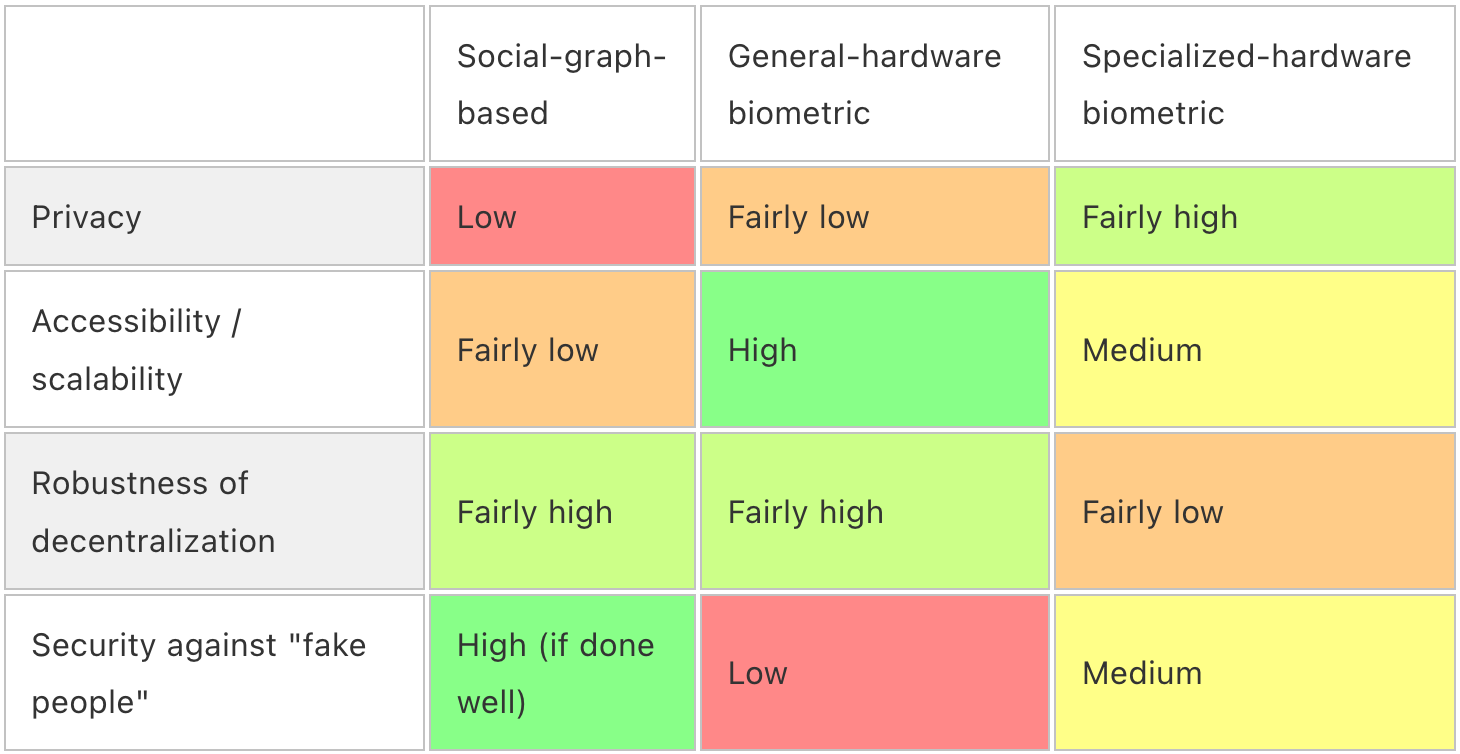
So there's a lot of activity here. Hopefully we get more applied implementations to learn from.
Okay that's enough
In all likelihood, the first implementations of systems in this space will be flawed and privacy-violating.🤡 In the US and Canada in particular, when has any government service been on-time and best-in-class?
Nevertheless, I'm not giving into defeatism here. I'm completely energized by the potential upsides of an internet that has trust again. This is all the more important in our AI-suffused world.
Public sentiment towards technology and governance is in a trough, maybe rightly so, but technology and governance is also one of the best things we've got. We need to save it from ourselves to save us from ourselves.